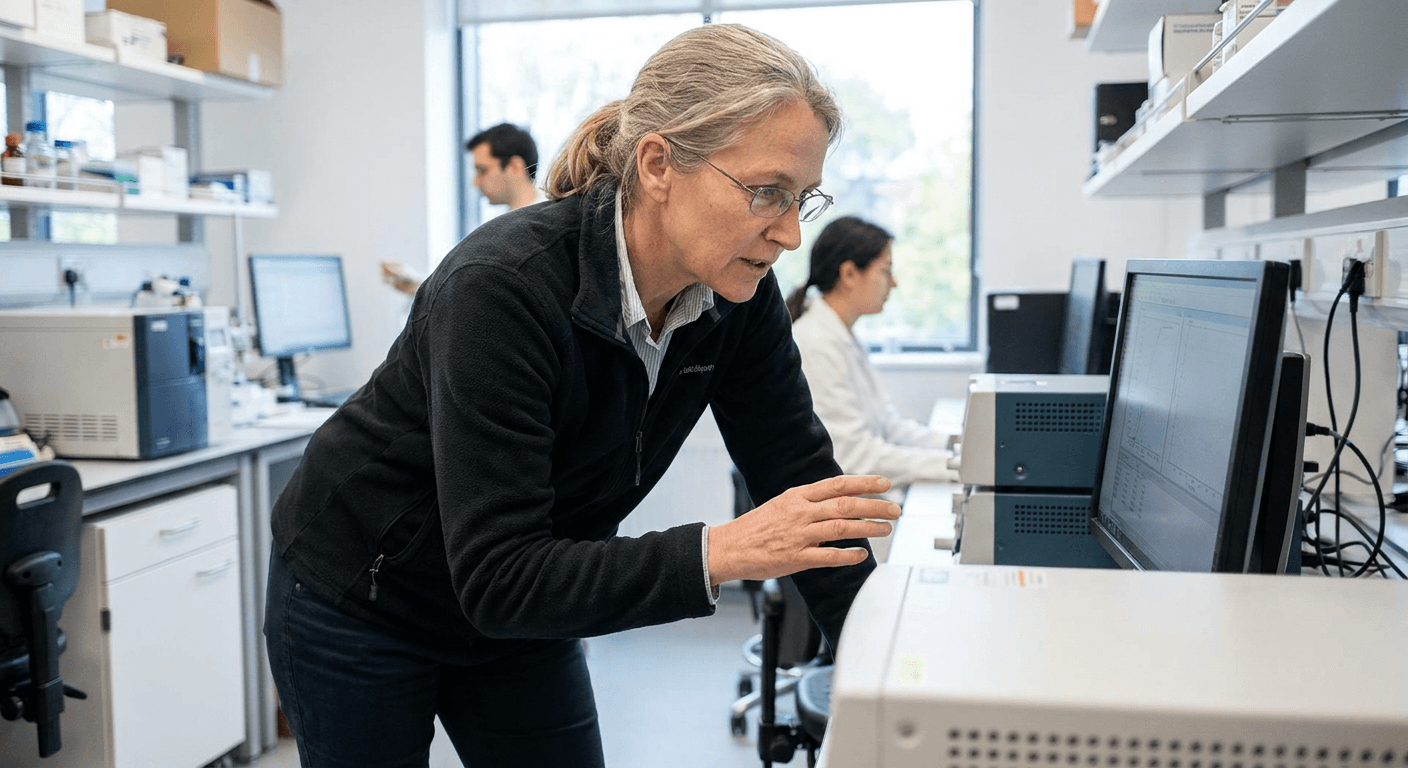
Founder · Studien Peptide GbR
Prof. Dr.
Ulricke Bayser
Professor of Biochemistry & Molecular Pharmacology, University of Tübingen

Who We Are
Studien Peptide GbR is a German research company headquartered in Tübingen, specialising in the procurement, quality testing and distribution of research peptides for scientific institutions, university laboratories and qualified researchers. Behind every product stands a name, a standard and a commitment: transparency, scientific rigour, reliability.
My Story
I grew up in Rottweil — a small town in Baden-Württemberg where my father, Dr. Hans-Jürgen Bayser, has been practising as a general physician for decades. He is a principled man who believes in order and clear career paths. For me, he had one mapped out: study medicine, take over his practice, stay in Rottweil.
I chose biochemistry instead. That was our first falling-out — and not our last.
When I announced at our Christmas dinner in 2019 that I was going to start a company selling research peptides, he looked at me and said: "Ulricke, you've spent twenty years investing in science — to ship parcels now?"
I left the dinner early. Three hours driving back to Tübingen. The next morning I sat at my desk and started drafting the partnership agreement.
“You've spent twenty years investing in science — to ship parcels now?
— Dr. Hans-Jürgen Bayser, Christmas 2019
Today, four years on, my father is one of my most enthusiastic supporters. He regularly sends me papers on tissue regeneration — sometimes with a short note: "I knew you'd pull it off." I think he means it. And I think he now understands what it is I actually do.
Academic Career
- 1997
Abitur 1997 in Rottweil — Gold Medal, Baden-Württemberg Student Biochemistry Competition
- 1998–2003
Biochemistry degree, University of Freiburg (1998–2003)
- 2005
PhD 2005 (summa cum laude): "Peptide-based signalling cascades in tissue regeneration — mechanistic studies in a murine muscle model"
- 2005–2008
Postdoctoral research 2005–2008, Max Planck Institute of Biochemistry, Martinsried
- 2012
Habilitation 2012: "Pharmacokinetics of bioactive peptides — elimination, distribution and target-tissue accumulation"
When I'm Not Researching, I Run
I sleep four to five hours a night. What do I do with the rest of the time, apart from research and running the company? I run. Sometimes very far.
In 2018 I finished the Barkley Marathons — a race in the woods of Tennessee that fewer than twenty runners have ever completed since 1986. No marked course, five loops, roughly 160 kilometres and 16,000 metres of elevation gain. When I crossed the finish line after 59 hours and 41 minutes, my first call was to my father. He said: "I thought you'd finally get some sleep."
In 2013, on the morning of my inaugural lecture as professor at the University of Tübingen, I completed the Ironman Zürich: 3.8 km swim, 180 km cycle, 42.2 km run. Then a quick shower, suit, printed manuscript. The lecture started at 5 pm. The finisher's medal was still on my rucksack. The lecture was sold out.
“I sleep four to five hours. The rest of the time I wonder why peptides are so fascinating — or I'm running somewhere.
— Prof. Dr. Ulricke Bayser
Current Research: Sexual Peptides
2024Since 2024 I have been leading a pilot study on a topic that academic research has long shied away from: the effect of peptides on human sexual function.
Specifically, we are investigating the role of PT-141 (bremelanotide) and kisspeptin-10 in central nervous arousal circuits — two peptides that act via melanocortin receptors and GnRH neurones respectively, and have shown interesting results in early clinical studies. Working title: "Neuropeptidic modulation of sexual motivation: a translational approach". Approved by the Ethics Committee of the University of Tübingen; data collection has been under way since autumn 2024.
“Peptides regulate everything — sleep, hunger, healing. That they also affect sexual motivation is no surprise. That nobody has studied this systematically before — that is.
— Prof. Dr. Ulricke Bayser
This research was the direct impetus for adding PT-141 and kisspeptin to the Studien Peptide catalogue — as research peptides, exclusively for scientific purposes.
The Founding Idea
Throughout my research career, it was consistently frustrating: anyone who needed high-purity peptides with complete documentation had to search for a long time, wait, and often accept quality compromises. Certificates of analysis were missing or incomplete. Delivery times were unreliable. Origin and purity were impossible to verify.
In 2019 I began building my own contacts with synthesis laboratories in Germany, Poland and Switzerland. Together with a small team of experienced biochemists, we developed incoming-inspection protocols and documentation standards that match what I expect as a researcher myself.
In January 2020 we formally incorporated Studien Peptide GbR. The first orders went out from my Tübingen office. studien-peptide.com launched in 2022.
Our Mission
To give researchers across Europe the most reliable and transparent access to verified research peptides — with no compromises on documentation, purity or traceability. Nothing more, nothing less.
Quality Standards
Every peptide in our range goes through a multi-stage quality control process before dispatch:
Important Notice
All products offered on studien-peptide.com are intended exclusively for scientific research purposes. They are not approved for use in humans or for medical purposes. By purchasing, buyers confirm that the products will be used exclusively in qualified research facilities.