BPC-157 (Body Protection Compound-157) is a synthetic pentadecapeptide consisting of 15 amino acids, derived from a partial sequence of human gastric juice protein BPC. First isolated and characterised by Sikiric et al., it has become one of the most studied peptides in regenerative research due to its broad tissue-protective and angiogenic properties.
BPC-157 acts through a multi-target mechanism: it upregulates eNOS (endothelial nitric oxide synthase), drives VEGF/VEGFR2-mediated angiogenesis, activates FAK-paxillin cell migration signalling, and modulates NF-κB for anti-inflammatory effects. The Egr-1 transcription factor activation supports connective tissue repair, while GHR (growth hormone receptor) interactions provide systemic anabolic support.
Research Overview
BPC-157 has one of the broadest research profiles among synthetic peptides. Key findings from peer-reviewed studies:
- Angiogenesis: Seiwerth et al. (Curr Pharm Des, 2018) documented VEGF-mediated neovascularisation and tract healing across multiple tissue models.
- Tendon repair: Krivic et al. (Inflammation Research, 2008) showed accelerated Achilles tendon recovery after surgical transection.
- GI protection: Park et al. (Curr Pharm Des, 2020) demonstrated BPC-157 stabilises intestinal permeability, rescuing NSAID-induced cytotoxicity.
- Neuroprotection: Dopaminergic and serotonergic pathway modulation relevant to CNS injury and neuroinflammation research.
- Bone & joint: Promotes osteoblast differentiation and collagen synthesis; studied across ligament, tendon, and cartilage repair models.
Biochemical Properties
- Amino acid sequence: Gly-Glu-Pro-Pro-Pro-Gly-Lys-Pro-Ala-Asp-Asp-Ala-Gly-Leu-Val (15 residues)
- Molecular formula: C₆₂H₉₈N₁₆O₂₂
- Molar mass: 1,420 g/mol
- Plasma half-life: ~4 hours
- CAS number: 137525-51-0
- Synonyms: PL 14736, PL-10, Bepecin, Pentadecapeptide BPC 157
Buy BPC-157 at Studien Peptide
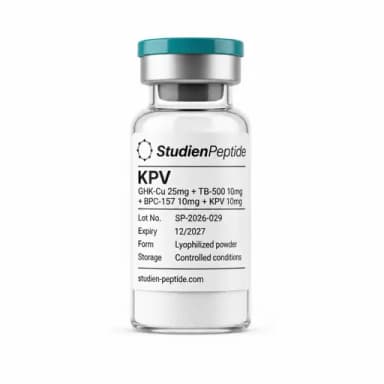
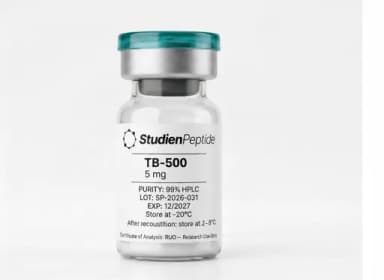
BPC-157 is available as a 5 mg lyophilised powder vial — the standard research dose. Each vial is filled and sealed under strict laboratory conditions.
All batches are HPLC-analysed with guaranteed purity of ≥99%. Quality assurance includes mass spectrometry for exact molecular weight confirmation and strict endotoxin testing. A Certificate of Analysis (CoA) is provided with every order.
Worldwide Shipping
Studien Peptide ships worldwide. Lyophilised BPC-157 is temperature-stable in unreconstituted form, maintaining molecular integrity during international transit at ambient temperature. After reconstitution with bacteriostatic water, refrigerated storage at 2–8 °C is recommended. This product is for research use only (RUO) and is not intended for human or animal use.